
Just as smoke rises like a ghostly specter in a haunted house, its movement within your home is governed by specific scientific principles. Understanding how smoke travels can be essential during a fire, as its behavior is influenced by factors like temperature and airflow. By grasping these dynamics, you can better prepare for emergencies. What strategies can you implement to protect yourself and your loved ones from the dangers of smoke?
How Smoke Moves: The Basics of Smoke Travel

When a fire ignites, smoke doesn’t just linger; it travels through your home in dynamic ways.
Understanding smoke behavior is essential for ensuring safety and minimizing damage. As smoke rises, it spreads horizontally and vertically, influenced by indoor dynamics like temperature, airflow, and the layout of your space.
Understanding smoke behavior is crucial for safety and reducing damage, as it disperses in response to temperature, airflow, and spatial layout.
Hot smoke ascends, filling upper areas first, while cooler, denser air pulls it downward, creating layers. Open doors, windows, and ventilation systems can alter this path, either facilitating or hindering smoke movement.
Recognizing these patterns helps you anticipate its spread and devise effective escape plans. By grasping the fundamentals of smoke travel, you empower yourself to protect your home and loved ones in the event of a fire.
Key Factors That Affect Smoke Movement Indoors
While understanding the basic principles of smoke movement is essential, several key factors greatly influence its behavior indoors.
First, smoke diffusion plays a critical role; as smoke spreads from a source, its particles mix with the air, affecting visibility and toxicity levels.
Second, airflow patterns within your home shape how smoke travels. Open doors and windows can create drafts that redirect smoke, while closed spaces may trap it.
Additionally, temperature differences can influence movement, with warmer smoke rising and cooler air descending.
Finally, the layout of your home, including walls and furniture, impacts how effectively smoke disperses.
Recognizing these factors can help you better understand the dynamics of smoke in your living environment.
Strategies to Minimize Smoke Damage During a Fire

Understanding how smoke moves indoors sets the stage for implementing effective strategies to minimize smoke damage during a fire.
First, establish robust fire prevention measures, such as installing smoke detectors and maintaining your electrical systems.
When a fire occurs, employ smoke containment strategies by closing doors and windows to limit smoke spread.
Utilize fans strategically to redirect smoke towards exits, and seal any gaps around doors and windows to keep smoke from infiltrating unaffected areas.
Additionally, cover vents with damp cloths to filter smoke.
Regularly practice evacuation plans, ensuring everyone knows their routes.
How Temperature Influences Smoke Movement
Temperature plays a vital role in how smoke moves within your home.
As hot air rises and cool air sinks, you’ll notice how these temperature differences create patterns that affect smoke distribution.
Additionally, pressure variations can further influence the speed and direction of smoke, making understanding these factors essential for fire safety.
Hot Air Rises
Heat naturally moves upward, creating a dynamic environment where smoke behaves similarly. When you light a fire, the hot air generated rises, forming specific rising patterns that dictate how smoke disperses.
This upward movement allows smoke to travel through various levels of your home, often reaching ceilings and upper floors before settling back down. The temperature difference between the hot air and cooler air in your living space plays a vital role in this process.
As the hot air rises, it carries smoke with it, which can affect visibility and air quality. Understanding these dynamics empowers you to manage smoke effectively, enhancing safety and comfort in your home.
Cool Air Sinks
Cool air plays an essential role in the movement of smoke within your home, often sinking to fill spaces left by rising hot air.
This cool air dynamics create a layering effect, where smoke rises and cool air settles beneath it. As you observe smoke in a room, you’ll notice it doesn’t disperse evenly; instead, it forms distinct layers based on temperature differences.
When a fire ignites, hot air and smoke rise, leaving cooler air to fill the void below, which can affect smoke distribution patterns. Understanding these dynamics helps you visualize how smoke travels and accumulates, allowing you to take informed actions to improve air quality and enhance safety during a fire event.
Pressure Differences Impact
As smoke rises and cool air sinks, the pressure differences created by varying temperatures greatly influence how smoke moves through your home. Understanding these pressure gradients is essential for effective air circulation and fire safety. Warm air creates lower pressure zones, drawing in cooler air, which in turn affects smoke’s path.
| Temperature Zone | Pressure Effect |
|---|---|
| Warm Air | Lower Pressure |
| Cool Air | Higher Pressure |
| Smoke Movement | Follows Pressure Gradients |
| Air Circulation | Enhanced by Temperature Differences |
Impact of Smoke Density on Visibility
Smoke density directly affects visibility within your home, as the concentration of smoke particles can obscure your line of sight.
You’ll notice that darker, denser smoke diminishes clarity more than lighter varieties, impacting your ability to navigate safely.
Additionally, understanding smoke movement patterns can help you anticipate areas of reduced visibility and enhance your response during a smoke event.
Smoke Particles and Visibility
When smoke particles fill a room, they considerably reduce visibility, creating an environment that can be disorienting and hazardous. The smoke composition plays an essential role in determining how these particles interact with light, leading to visibility challenges. As the density of smoke increases, your ability to see clearly diminishes, complicating escape routes during emergencies.
| Smoke Density Level | Visibility Impact |
|---|---|
| Low | Minimal reduction |
| Moderate | Noticeable challenges |
| High | Severe disorientation |
Understanding these factors helps you prepare for smoke encounters, whether in a home or any enclosed space. Awareness of smoke’s impact on visibility can empower you to take immediate action in case of a fire.
Color and Density Effects
Different colors of smoke can greatly influence how density affects visibility in enclosed spaces.
When smoke density increases, you may notice that the color perception shifts, making it harder to distinguish between different shades. For instance, darker smoke—like that from burning rubber—can obscure visibility more than lighter smoke, even at similar density variations.
As you navigate through a smoke-filled area, the interplay of color and density can create an environment where clarity rapidly diminishes. This phenomenon underscores the importance of understanding how various smoke colors can impact your ability to see and react.
Smoke Movement Patterns
As smoke density increases, its movement patterns can significantly affect visibility within enclosed spaces. You’ll notice that high-density smoke restricts vision, creating a disorienting environment.
This phenomenon results from smoke diffusion, where particles disperse unevenly, influenced by fire dynamics and airflow. In tightly sealed areas, smoke accumulation can lead to rapid visibility loss, making navigation perilous.
Conversely, in more open environments, smoke may dissipate faster, allowing for clearer sightlines. Understanding these patterns is essential for safety, as it helps you identify potential escape routes during a fire.
Awareness of smoke behavior can empower you to take proactive measures, ensuring you maintain control and maximize your chances of safely exiting a smoke-filled area.
How Ventilation Systems Affect Smoke Behavior?
Ventilation systems play an essential role in shaping how smoke behaves within a home, influencing its movement and concentration levels. Understanding ventilation types and airflow dynamics can help you mitigate smoke hazards effectively.
| Ventilation Type | Effect on Smoke Behavior | Airflow Dynamics |
|---|---|---|
| Natural Ventilation | Allows smoke to escape easily | Relies on temperature and pressure differences |
| Mechanical Ventilation | Can contain or exhaust smoke | Uses fans to control air movement |
| Hybrid Ventilation | Combines both methods | Adapts to environmental conditions |
Why Smoke Alarms Matter in Fire Safety
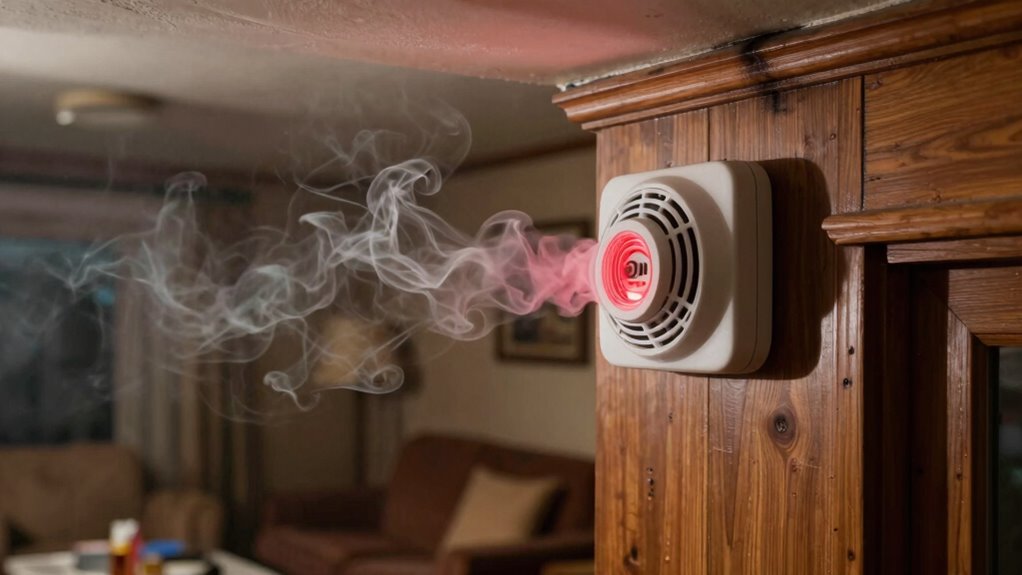
While you might think of smoke alarms as just another household device, their role in fire safety is critical. Effective fire alarm technology can mean the difference between a minor incident and a catastrophic event.
Smoke detection importance lies in its ability to alert you to danger before it becomes overwhelming. Early detection gives you and your loved ones precious minutes to evacuate or respond appropriately. Statistically, homes with functioning smoke alarms notably reduce the risk of fire-related fatalities.
Regular maintenance and timely battery changes enhance their reliability. By understanding the significance of these devices, you empower yourself to take control of your safety.
Ultimately, investing in smoke alarms is an essential step toward protecting your freedom and well-being in your home.
Frequently Asked Questions
Can Smoke Travel Through Walls and Ceilings?
Yes, smoke can travel through walls and ceilings due to differences in smoke density and air pressure. These factors allow smoke to seep into adjacent spaces, making it essential to guarantee proper ventilation during a fire.
What Role Does Humidity Play in Smoke Movement?
Humidity’s effects can surprisingly enhance smoke movement, as moist air carries particles more efficiently. Increased humidity can improve air circulation, allowing smoke to spread faster. So, ironically, dampness might make your home feel less safe.
How Does Furniture Placement Affect Smoke Flow?
Furniture placement greatly impacts smoke flow. High furniture density can obstruct airflow patterns, causing smoke to accumulate. To enhance ventilation and reduce smoke retention, consider spacing furniture strategically to promote better air circulation throughout the space.
Is Smoke Inhalation Risk Higher on Upper Floors?
When smoke rises like a dark cloud, it thickens on upper floors due to decreased ventilation. This increased smoke density heightens inhalation risks, making those levels more dangerous during a fire compared to lower floors.
Can Smoke Spread Faster in Certain Materials?
Yes, smoke can spread faster through certain materials. Smoke density and material composition greatly influence how quickly smoke travels, as porous or synthetic materials may allow for quicker absorption and dissemination of smoke particles within an environment.